Best Seller Icon Bestseller

Diploma In PGDCA(M-DP-9863)

  • Last updated Sep, 2026
  • Certified Course
₹11,999 ₹14,999

Course Includes

  • Duration12 Months
  • Enrolled0
  • Lectures120
  • Videos0
  • Notes0
  • CertificateYes

What you'll learn

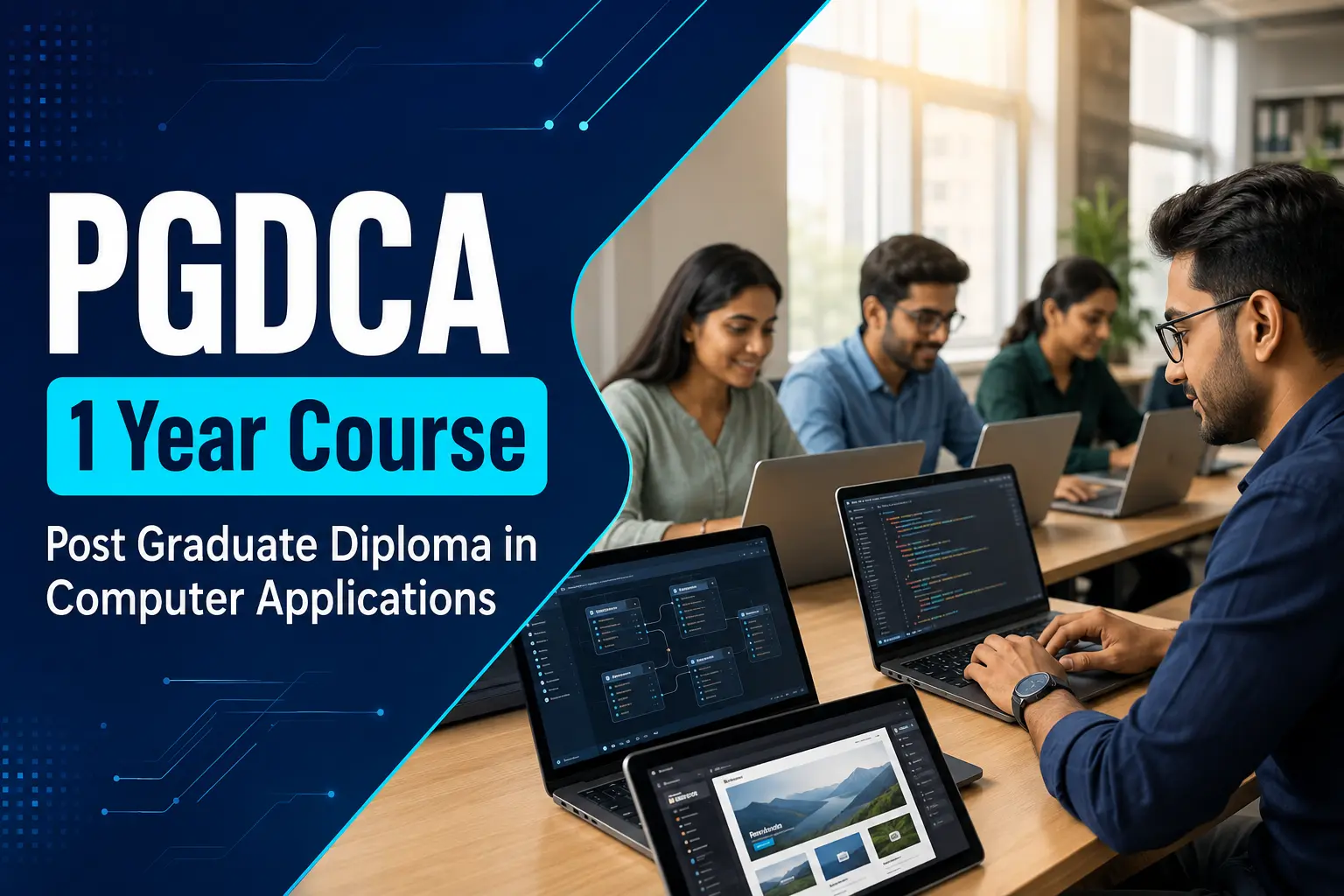
Post Graduate Diploma in Computer Applications (PGDCA)

PGDCA (Post Graduate Diploma in Computer Applications) is a career-oriented computer education programme designed to provide students with comprehensive knowledge of computer applications, programming, databases, software development, office automation, and modern information technology.

The course combines theoretical concepts with practical, hands-on training, enabling learners to develop the technical skills required for today’s digital workplace. Students gain a strong foundation in computer fundamentals, operating systems, programming languages, database management, web technologies, networking, and application development.

Key Areas Covered

  • Computer Fundamentals & Operating Systems
  • MS Office & Office Automation
  • Programming Concepts and Languages
  • Database Management Systems (DBMS)
  • Data Structures
  • Web Designing & Development
  • Computer Networking
  • Software Engineering
  • Internet & Digital Technologies
  • Project Work and Practical Training

Course Objectives

The PGDCA programme aims to:

  • Build strong computer and IT fundamentals.
  • Develop programming and problem-solving skills.
  • Provide practical knowledge of software and database applications.
  • Prepare students for professional IT environments.
  • Develop skills for employment, entrepreneurship, and further studies in the field of Information Technology.

Career Opportunities

After completing PGDCA, students can explore opportunities in areas such as:

Computer Applications, IT Support, Data Management, Web Development, Software Assistance, Office Automation, Database Operations, Computer Training, and Digital Services.

PGDCA is an ideal choice for graduates and learners who wish to upgrade their computer skills and build a career in the rapidly growing Information Technology sector.

Show More

Course Syllabus

PGDCA – Post Graduate Diploma in Computer Applications

Course Duration

1 Year | 2 Semesters

Course Structure

SEMESTER – I

Paper 1: Computer Fundamentals & Information Technology

  • Introduction to Computers
  • Evolution and Generations of Computers
  • Types and Classification of Computers
  • Computer Hardware and Software
  • Input and Output Devices
  • Memory and Storage Devices
  • Number Systems
  • Data Representation
  • Operating Systems – Concepts and Functions
  • Windows Operating System
  • File and Folder Management
  • Internet Fundamentals
  • Email and Online Services
  • Cyber Security Fundamentals

Paper 2: Office Automation & Productivity Tools

  • Word Processing
  • Microsoft Word
  • Document Formatting and Page Layout
  • Tables, Mail Merge and Templates
  • Microsoft Excel
  • Worksheets, Formulas and Functions
  • Charts and Data Visualization
  • Sorting, Filtering and Data Management
  • Microsoft PowerPoint
  • Presentation Design and Animation
  • Google Workspace / Cloud Productivity Tools
  • Practical Office Automation

Paper 3: Programming in C

  • Programming Fundamentals
  • Algorithms and Flowcharts
  • C Programming Environment
  • Variables, Constants and Data Types
  • Operators and Expressions
  • Conditional Statements
  • Loops and Iterations
  • Functions
  • Arrays
  • Strings
  • Pointers
  • Structures and Unions
  • File Handling
  • Introduction to Object-Oriented Programming Concepts
  • Practical Programming Exercises

Paper 4: Database Management System (DBMS)

  • Introduction to Databases
  • Database Concepts and Architecture
  • Data Models
  • Relational Database Model
  • Tables, Records and Fields
  • Keys and Relationships
  • Entity Relationship Model
  • Normalization
  • SQL Fundamentals
  • DDL, DML and DCL
  • Queries and Functions
  • Joins and Subqueries
  • Views
  • Database Security
  • Practical Database Exercises


SEMESTER – II

Paper 5: Data Structures & Algorithms

  • Introduction to Data Structures
  • Algorithms and Complexity
  • Arrays
  • Linked Lists
  • Stacks
  • Queues
  • Trees
  • Graphs
  • Searching Techniques
  • Sorting Techniques
  • Recursion
  • Basic Algorithm Analysis
  • Practical Implementation

Paper 6: Web Technology & Web Development

  • Introduction to Internet and Web
  • Web Architecture
  • HTML5
  • Text Formatting and Links
  • Images, Tables and Forms
  • CSS3
  • Selectors and Styling
  • Responsive Web Design
  • JavaScript Fundamentals
  • Variables and Data Types
  • Functions and Events
  • DOM Basics
  • Form Validation
  • Introduction to Bootstrap
  • Introduction to Web Hosting
  • Practical Website Development

Paper 7: Computer Networking

  • Introduction to Computer Networks
  • Types of Networks – LAN, MAN and WAN
  • Network Topologies
  • Networking Devices
  • Transmission Media
  • OSI Model
  • TCP/IP Model
  • IP Addressing
  • IPv4 and IPv6
  • Network Protocols
  • Internet and Intranet
  • Wireless Networking
  • Network Security
  • Introduction to Cloud Computing
  • Basic Network Configuration and Troubleshooting

Paper 8: Software Engineering & System Analysis

  • Introduction to Software Engineering
  • Software Development Life Cycle (SDLC)
  • Requirement Analysis
  • Feasibility Study
  • System Analysis and Design
  • Software Design
  • Software Development Models
  • Testing Fundamentals
  • Software Maintenance
  • Project Management
  • Documentation
  • Quality Assurance
  • Agile and Scrum Fundamentals

Paper 9: Emerging Technologies

  • Artificial Intelligence – Introduction
  • Machine Learning – Basic Concepts
  • Cloud Computing
  • Internet of Things (IoT)
  • Big Data – Introduction
  • Blockchain Technology – Fundamentals
  • Digital Payments
  • Cyber Security Awareness
  • Data Privacy and Protection
  • Generative AI – Introduction and Applications
  • Current Trends in Information Technology

Paper 10: Project Work & Practical Training

Students will undertake a practical project based on computer applications or information technology.

Suggested Project Areas:

  • School/College Management System
  • Library Management System
  • Inventory Management System
  • Billing System
  • Payroll Management System
  • Hospital Management System
  • E-Commerce Website
  • Educational Website
  • Database Application
  • Small Business Automation System

Practical Training

Practical sessions will focus on:

  • Office Automation
  • Programming
  • Database Management
  • Web Development
  • Networking
  • Software Installation and Troubleshooting
  • Internet and Digital Services
  • Project Development

Assessment Pattern

  • Theory Examination
  • Practical Examination
  • Internal Assessment
  • Assignments & Class Tests
  • Project Work
  • Viva Voce

Learning Outcomes

After successful completion of PGDCA, students will be able to:

  1. Understand fundamental concepts of computers and information technology.
  2. Efficiently use modern office productivity applications.
  3. Develop programs using programming concepts.
  4. Design and manage relational databases.
  5. Create basic dynamic and responsive websites.
  6. Understand computer networking and troubleshooting.
  7. Apply software engineering principles to IT projects.
  8. Analyze and solve basic computational problems.
  9. Understand emerging technologies and their applications.
  10. Develop and implement an IT-based project independently.

Career Opportunities

PGDCA graduates can pursue opportunities as:

  • Computer Operator
  • IT Support Executive
  • Data Entry / Data Management Executive
  • Office Automation Executive
  • Junior Programmer
  • Web Developer
  • Database Assistant
  • Technical Support Executive
  • Computer Trainer
  • System Support Assistant
  • Digital Service Executive
  • IT Assistant

The syllabus may be adapted by the institute according to academic requirements, industry trends, and applicable university/council guidelines.

Eligibility

Who can apply for this course

Minimum 10th Pass

Course Fees

Course Fees
:
₹14999/-
Discounted Fees
:
₹ 11999/-
Course Duration
:
12 Months

Review

0.0
Course Rating (0 reviews)
0%
0%
0%
0%
0%


Call
Text Message
Review
Email
CHAT